
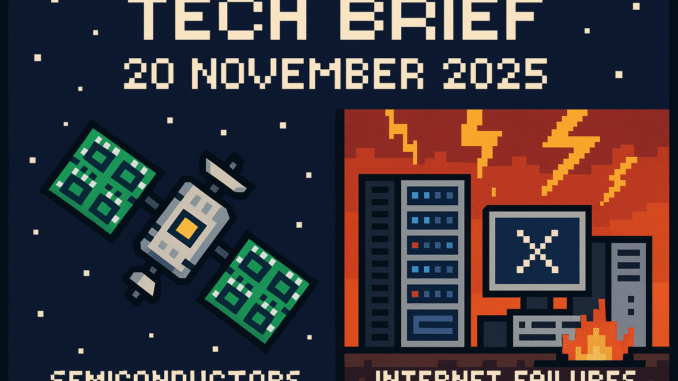
Tech Brief 20 November 2025 lands with Britain’s semiconductor ambitions, internet reliability failures, and fresh skirmishes over consumer rights all jostling for attention. Some days, it is comforting to see the old debates about chips, networks, and tech ownership never truly retire. Missed yesterday’s Tech Brief? Catch up here before diving in.
BAE Systems Expands UK Space Industry with New Radiation-Hardened Circuitry
BAE Systems has unveiled its RH12 platform, a 12-nanometre semiconductor line designed for extreme radiation resilience in orbit. This is not app store glitz or a PR stunt. It is the sort of solid engineering that built Britain’s computing reputation back in the Ferranti and Inmos heydays. The country’s space ambitions rely on hardware that survives brutal cosmic conditions, and BAE’s latest is a direct answer.
Tech like this carries the unheralded legacy of the “Made in Britain” ethos. For anyone following British microchip history, the move ties back to 80s innovation, when circuit boards were more than just imported parts. Now, this home-grown approach is about satellites, not Sinclair Spectrums, but the mindset is the same: engineering with an eye on reliability.
Nobody is live-streaming these chips’ journeys. Britain’s digital reach would not exist without them. There are many quiet victories happening far from the high street.
Cloudflare Outage Shows Internet Still Has Fragile Bones
“Why can’t you just fix it yourself anymore?” That is what a lot of us wondered when Cloudflare’s systems went haywire, blacking out sites everywhere. Cloudflare routes traffic, fights spam, and protects millions of websites. In other words, it is the hidden scaffolding of the modern internet.
On Tuesday, a single point of failure proved how little redundancy there is in today’s web. Older hands will shrug, remembering when sysadmins carried floppy disks like rosaries. In 2025, if Cloudflare drops, even the status page might disappear with it. This is not just a story about downtime. It is about how abstraction has tied us to infrastructure we cannot see, let alone tinker with.
If you want a callback, look at BAE’s chips above: two sides of tech reliability. One is built for cosmic mayhem, the other felled by a misstep in a server stack. These days, not even a browser refresh can save the day.
Which? Launches £3bn Legal Offensive On Apple’s iCloud Tactics
Here’s a scene: Which?, the consumer group your parents probably trusted to sort their VCR warranty headaches, is now taking Apple to court over what it says is exploitative iCloud pricing. That is a £3 billion shot across the bows, with Which? claiming 41 million UK users are unfairly boxed into Apple’s ecosystem.
Apple strongly denies the claim, but the case is set for a courtroom battle. The deeper issue is digital lock-in, that familiar trap from cartridge-era home computing, now sprawling across our everyday data. A bit of nostalgia here: Which? has always been the champion for users caught in small print, and their move signals British consumer advocacy is still stubbornly alive among the megacorps.
How much control do any of us really have? This time, it is cloud storage instead of TV remote controls, but the lesson is hauntingly similar.
AI Agents Crash Amazon’s Monopoly Party
A lawsuit over AI shopping assistants is making unlikely waves. Perplexity, once a plucky upstart, now faces Amazon in what some call the “AI agent war.” This is not about chatbots answering trivia. It is automated software making choices for users, directly challenging one of the biggest names in retail.
If it sounds familiar, it is not a coincidence. Some see shades of the old browser wars, when Netscape dominated the 1990s before Mozilla’s open-source rebellion gave back agency to tinkerers. Back then, DIY rebels and self-proclaimed enthusiasts shaped the web. The new AI platform battle, however, lacks that sense of communal resistance.
A lot hangs in the balance for the digital high street. For now, we all wait to see if any genuine choice will survive the next wave of automation.
From the Wayback Machine
On This Day: 1985 – Microsoft Windows 1.0 was released, requiring an Intel 8088 processor, two floppy drives, and a graphics adapter. Its desktop had tiled windows only, a mouse that confused nearly everyone at first, and a Control Panel many dismissed as a gimmick. Reviews were modest and multitasking was limited, but this version quietly introduced foundations for modern personal computing: user-friendly design, graphical programs, and software interoperability. A generation soon moved from command prompts to point-and-click.
What This Means
Tech Brief 20 November 2025 is a reminder that progress is rarely tidy. British space chips, cloud service fragility, and old-school advocacy against Big Tech all share a lineage: someone, somewhere, pushing for reliability and real choice. New names, same old DIY spirit.
Find a floppy, check your backups, and spare a thought for the quiet workhorses behind every “it just works” claim. Digital nostalgia is best served warm.
Missed yesterday’s Tech Brief? Catch up here
Leave a Reply