
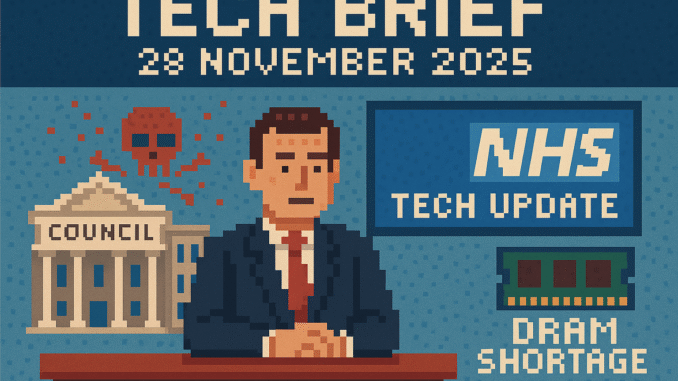
“It’s not just you.” Tech Brief 28 November 2025 comes packed with fresh digital headaches from council hacks to vanishing memory chips, plus some overdue NHS upgrades. Cyber mischief, budget hopes, and old-school hardware panic all come knocking. Déjà vu? You’re in familiar company.
Missed yesterday’s Tech Brief? Catch up here before diving in.
Three London Councils Hit by Cyber-Attack
“What happens if the whole council floor goes dark?” That question got real for staff across Kensington and Chelsea, Westminster, and Hammersmith and Fulham this week. A large-scale cyber-attack forced three central London councils to shut down phone lines and scramble emergency playbooks. Investigators from the National Crime Agency arrived, highlighting how crucial, and vulnerable, shared public IT infrastructure remains.
This isn’t a classroom server crash anymore. Council websites, phones, housing apps, staff systems, all offline. For residents, routine tasks like paying rent or arranging recycling turned into days of uncertainty. You can almost hear the sigh of anyone who spent the nineties bodging together a home LAN or cursing ClarisWorks after hours.
It’s another reminder that even after thirty years, critical UK systems are so tethered together that one breach can ripple everywhere. Is there a masterplan for resilience, or are we just rebooting and hoping for the best?
Chancellor Pledges £300m to Modernise NHS Technology
The Autumn Budget will finally send £300 million to refresh NHS tech infrastructure. After years of being written off as too slow or underfunded, sprawling hospital systems are about to get the investment so many have been crying out for. The money will buy badly needed hardware upgrades, streamline staff workflows, and, with luck, replace the ancient operating systems still lurking behind reception desks and inside laboratories.
Anyone who watched reception staff wage war with a Windows 95 login knows just how overdue this is. Some NHS clinics still rely on software and equipment from the late nineties. GPs and nurses have reported bizarre crashes, printers seizing up, or records getting lost in a sea of popups.
Modernising isn’t glamorous, but it keeps medicine running. Hopefully, this budget will reach the frontline, not just the procurement committee. What’s the point of AI diagnostics if your appointment system still boots from a floppy?
Chipmakers Warn of Looming DRAM and SSD Shortage
A cold fact: memory makers say they can’t keep up. DRAM and SSD supplies are under threat as hyperscale cloud companies, the backbone of everything from public services to gaming, snap up stock at record rates to support new AI workloads. Market analysts are already forecasting higher prices for consumers, and some factory managers warn shortages could last into 2027.
Most tech users haven’t had to queue for RAM since the 1980s, yet the same scarcity mindset lingers. Back in the days when a single RAM chip cost as much as a night out, shortages triggered panic, hoarding, and endless pub debates about “just how much memory you really need.” This time, the stakes are invisible but enormous.
Today, the difference is scale. It’s not home users, but vast data centres eating up supply, all so our apps load a few milliseconds faster. Will consumer kit be priced out next year? Difficult to call, and for now, history rhymes instead of repeating.
European Parliament Pushes for Social Media Ban for Under-16s
Should kids under sixteen face a lockdown on social media? This week, the European Parliament voted overwhelmingly to call for platforms to bar under-16s unless parents opt in. European headlines buzzed, campaigners cheered, and industry lobbyists started drafting their appeals.
It’s a move full of tension. Policymakers grew up believing the web should be open, but now child welfare concerns take centre stage. Mental health experts warn about social platform effects, yet enforcing bans at scale could push young people towards riskier corners of the internet. There’s no neat comparison to the nineties, unless you count Net Nanny or CyberPatrol, but even then, these were family debates, not legal mandates.
Would this fix digital childhood, or just create fresh battles over what “online safety” means? The policy conversation isn’t done, not by a long shot.
From the Wayback Machine
On This Day: 1972 – Pong Arrives in Arcades
Atari released Pong on 29 November 1972, which is technically tomorrow as this goes out. The game delivered addictive bat-and-ball simplicity in a dedicated console you could find in pubs and chip shops. Allan Alcorn’s engineering, inspired by Tennis for Two, created Pong’s signature bounce and sound effects. With its dedicated cabinet and coin slots, Pong became an instant fixture, shipping thousands of units in a few months. The action was so compulsive, some coin boxes jammed from overuse. That first era of video gaming laid the groundwork for nearly everything that followed, and Pong’s signature blip is still fondly remembered by collectors and designers alike. If you ever struggled to notch a point, you’re among friends.
Today’s Big Question
Tech Brief 28 November 2025 circles three decades of digital fragility, patchwork fixes, and nostalgia for simpler times. Are we finally learning from the past, or do these cycles just keep spinning? Would love to hear your take.
Stay curious, stay compassionate, and if your favourite gadget’s seized up for the hundredth time, at least you’re in good company.
Missed yesterday’s Tech Brief? Catch up here
Leave a Reply