
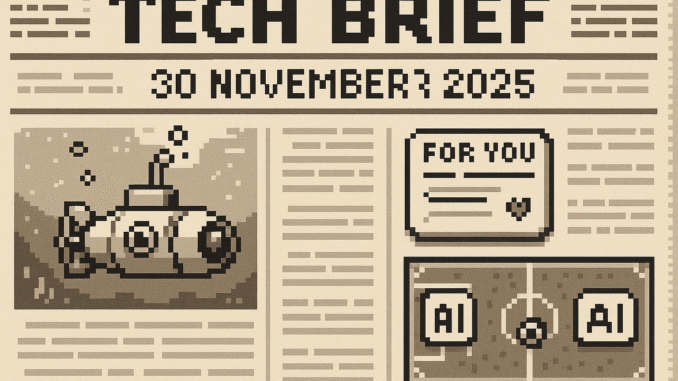
“It’s not just submarines getting smarter; our news feeds and football clubs are evolving too.” Tech Brief 30 November 2025 pulls focus on three pressure points: the rise of British sub drones, the consequences of algorithm-driven newsfeeds, and how AI is changing decision-making from workplaces to regional football. The intersection of tradition and technology is never quiet for long.
Missed yesterday’s Tech Brief? Catch up here before diving in.
A step-change below the waves: UK tech firms battle for submarine drone supremacy
“Machines don’t get seasick,” joked a Royal Navy engineer, but there’s nothing trivial about the current race to deploy autonomous underwater vehicles in British waters. Defence giants and nimble startups are battling to supply submarine drones for everything from snap infrastructure protection to endless anti-submarine patrols. The Guardian reveals just how intense things have become, noting that the technology, or at least the ambition, now rivals the anxiety that stalked British headlines during the Cold War. Despite radical advances in autonomy, there’s still a familiar tension. Will these AI-driven vessels serve national interest or just the bottom lines of their makers?
Access to real historical sources remains crucial here. The original 1980s manuals for British sub tech flagged reliability risks that echo in today’s much smarter engineering. A fair question: who’s responsible if the new generation of robots learns tricks the old sonar operators would not recognise?
X’s ‘For You’ feed tweaks can rapidly drive political polarisation, says new study
Here’s a new anxiety. Research shared by The Guardian shows that even minor changes to the “For You” feed on X, formerly Twitter, accelerated user polarisation at a rate once measured in years. A seven-day algorithmic adjustment can now shift opinions as much as several years of media drift once did.
The study’s authors highlight how algorithmic nudges now act as hidden editors, shaping what people see and eventually what they think. This is, in many ways, the latest chapter of an old antagonism between controlling the news and giving people what they want, or what generates profit. Watch out for downstream impacts. The echoes of these machine-mediated shifts may soon reshape not just national politics but personal relationships. Algorithms do not care about historical context, but their consequences still land on human households.
Shrewsbury Town leans on AI for recruitment and strategy
Why is a Midlands football club talking algorithms in the same breath as player stats? For Shrewsbury Town, embracing AI is less about imitating Premier League giants and more about turning local insights into sharper squad decisions. Manager Michael Appleton insists human judgement remains king, even with AI in the tactical mix.
This Shropshire Star feature underscores how digital transformation isn’t bound for London alone. Even outside the capital, community clubs want to use every tool available, computers included. The real story here is regional pride. The technology may be new, but the tension between trusting numbers or trusting instincts feels as old as a muddy match day. Decision support has gone from the BBC Micro to the cloud. The rivalry between person and program lives on.
Business software: Empowering workers, or digital leash?
Can modern business software genuinely empower staff? This question sits at the centre of ComputerWeekly’s Acclaim Autism case study. Their AI system reportedly lets employees override decisions, increasing task autonomy and speeding up claims. The results: insurance approvals have climbed, but some still fear increased surveillance.
Historically, new tools offered promises of liberation, but anyone who fought with clunky macros or restrictive firewalls knows liberation is always partial. It’s a real paradox; greater discretion on paper, enforced by yet another system in practice.
As illustrated above in Shrewsbury, the interplay between human choices and digital “help” is everywhere. Do you genuinely trust your new tools, or are they quietly keeping score?
From the Wayback Machine
On This Day: 1872 – The first international football match was played at Hamilton Crescent, Glasgow, between England and Scotland. More than 4,000 spectators watched two teams test their mettle, marking a milestone that would echo through every level of British sport. No digital scoreboard, no television broadcast, just printed notices and crowds jostling for a view. It reminds us how far communication and competition have come, and how spirit drives technology forward, not the reverse.
Today’s Big Question
When lines blur between human and machine, who owns the outcome? Tech Brief 30 November 2025 may not answer that, but the tension runs through submarines, newsfeeds, and even a Shropshire football club. Is it progress if we’re not quite sure who is in control?
Switch off, reboot, or just make a proper cup of tea. Tomorrow’s tech will still be here, humming away. Stay curious, stay awkward, and keep your own score.
Missed yesterday’s Tech Brief? Catch up here
Leave a Reply