
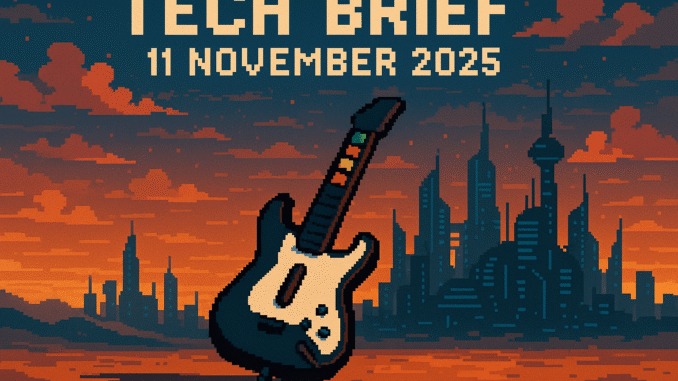
“People laughed when I brought a plastic guitar to a house party.” Tech Brief 11 November 2025 lands with a look at nostalgia colliding with disruption. Today’s stories cover the lasting legacy of Guitar Hero, AI-powered objections jamming up British planning, the ambitious Equinox innovation hub in Oxford, and the Post Office’s stubborn extension of its infamous Horizon system. Here’s what’s making the news.
Missed yesterday’s Tech Brief? Catch up here before diving in.
Guitar Hero at 20: Still Turning Bedrooms Into Arenas
When Guitar Hero landed in UK shops in the mid-2000s, it made plastic one of the most coveted building materials alongside Bakelite and LEGO. Developed by Harmonix with a nod to the earlier Konami arcade craze, the game let anyone become a rock legend; no blisters required. Real guitars may never have smelt like hot resin, but that unmistakable whiff of the RedOctane guitar controller is as clear in memory as a BBC Micro start-up beep.
Anyone who’d spent years wrestling MIDI software or building mixtapes suddenly had a way to riff with their kids or lose a late night to Queen’s “Killer Queen”; no actual talent required.
That communal, slightly shambolic magic is something you can’t always patch in. Have we seen a living room multiplayer moment like it since?
AI-Powered Planning Objections Jam Britain’s Bureaucracy
Would you trust a bot to defend your local park from redevelopment? This week, the launch of Objector, an AI-driven planning tool, put that faith to the test. The software churns out objections to proposed UK developments, drawing from policy documents to make “official” complaints only minutes after plans are filed.
Some see it as digital empowerment. Others call it a digital horseman of civic chaos. Local planning authorities, already buried under paper and PDFs, now face waves of algorithmically generated opposition.
It’s a far cry from the odd handwritten “No Flats Here” sign in a 1980s corner shop. The tension? Automation was meant to make planning smarter. Instead, we have AI turning Great British NIMBYism into a lightning-fast, sometimes faceless, political machine.
Oxford’s Equinox Project Aims for the Innovation Crown
Oxford University and the city’s civic partners are launching Equinox, an innovation consortium that wants to cement Oxfordshire’s place as a European technology engine. The focus is collaboration, pulling together business, government, and academia into one regional hub.
If you remember when “innovation” meant electronics club meetings or kitchen-table hacks, this is a stark change. Equinox’s power lies in uniting institutional heft and creative grit, building on the region’s legacy with Britain’s computing giants; think Acorn, ARM, and the rest.
Whether this model can outlast previous “Silicon Fen” booms is anybody’s guess. There is a growing desire for home-grown tech infrastructure, especially as public systems like the Post Office’s Horizon keep limping on despite notorious scandals.
Post Office Keeps Fujitsu Horizon; Scandal Lingers On
Just when it seemed the Horizon story might fade, the Post Office extended the contract with Fujitsu, keeping the faulty IT system in place until at least 2027. Horizon’s software, infamous for its errors that led to serious miscarriages of justice, lives on thanks to a further £41 million payout.
Sub-postmasters continue to demand accountability. Public confidence, never strong since the system’s earliest bugs surfaced in Computer Weekly over twenty years ago, is back in the spotlight. How do these decisions keep getting made? Whether you once used a battered CRT in the back office or relied on Horizon printouts, the lesson is clear: British tech infrastructure rarely lets go of a faulty system without an epic struggle.
From the Wayback Machine
On This Day: 1942 – Robert F. Engle, a key figure in financial econometrics, was born. Engle’s ARCH model, released in the 1980s, allowed financial risk modelling using time-varying volatility. His technique still underpins algorithmic trading, regulatory decision-making, and fintech tools today. Early financial computing relied on slower, simpler models. Engle changed that, and risk analysis has never looked the same.
What This Means
Tech Brief 11 November 2025 spotlights how British tech culture clings to the old, even as new tools shake up daily life. Historical cycles repeat, from shared living room joys to endless institutional contracts. Whether you’re welding a project in the shed or reading research on your phone, legacy matters.
Brew up, dust off your favourite controller, and write in with your best tech near-misses. See you tomorrow.
Missed yesterday’s Tech Brief? Catch up here
Leave a Reply