
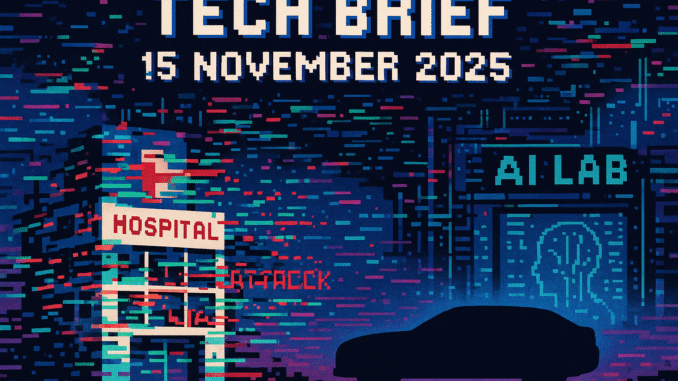
Tech Brief 15 November 2025 asks what’s urgent in British tech right now. Cyberattacks are hammering the NHS, Jaguar Land Rover is counting massive losses, and North Wales is getting the AI spotlight. There’s no tidy theme, just the tangled mess of digital life in the UK. Missed yesterday’s Tech Brief? Catch up here before diving in.
Ransomware Hits NHS: Cl0p Group Claims Responsibility
“Another day, another breach. You have to worry,” said an NHS sysadmin in a staff memo leaked online. The ransomware gang known as Cl0p claims to have targeted the NHS, leaving many public digital health systems under urgent review. Authorities haven’t shared details, but NHS IT teams are scrambling to contain the damage.
Ransomware is malicious software that encrypts files or locks access to vital systems until a ransom is paid. For many, the NHS stands almost as a national symbol, so when its networks turn into digital battlegrounds, the consequences go beyond inconvenience. The risk is personal: urgent referrals delayed, digitised records lost, treatments rescheduled due to system downtime. There’s plenty of frustration from staff carrying ageing terminals and modern cloud portals in the same hospital, sources cite both.
Watching cyber-criminals test the backbone of British public services, you can’t help but feel the human stakes.
Jaguar Land Rover Reports £485m Cyberattack Loss
£485 million. That’s the direct punch Jaguar Land Rover took this quarter after production lines fell silent for six weeks because of a major ransomware attack. The breach exposed the digital underbelly of a British automotive icon with roots stretching back to the days before microcomputers in Coventry.
Ransomware, once just an IT manager’s bogeyman, is now in the boardroom. The heritage company had built a reputation on mechanical brilliance, but you can have flawless gearboxes and still get outmanoeuvred by invisible code.
While factories try to catch up, doubt lingers. As digital control systems multiply in manufacturing, even the classic names are exposed. This is where industry pride meets modern digital risk. It’s a lesson for every business with one foot planted firmly in analogue hardware and the other in the cloud.
AI Growth Zone Confirmed for North Wales
Here’s a fact: North Wales has just been named the UK’s next AI Growth Zone. The government promises streamlined planning, new infrastructure, and thousands of jobs, all with the aim of pushing tech investment beyond the M25.
Anyone who’s followed British digital policy for a while might get a sense of déjà vu from this. The 1980s saw similar regional pushes: Cambridge and Glasgow were the big names then. Now, the focus is on AI labs, datacentres, and skills hubs far from London. Maybe this time, the skills and funding land where they’re meant to.
It’s not just about jobs and code. As AI infrastructure spreads, energy needs rise in tandem. There’s a callback here to the National Grid’s Didcot substation expansion. Wires and watts are moving north too.
Post Office Eyes Fujitsu Extension: Horizon Scandal Not Over
No neat endings here. The Post Office and Fujitsu may keep their controversial partnership running until 2028. This follows years after the Horizon software scandal, which saw hundreds of subpostmasters wrongly prosecuted due to flawed IT. The episode is still cited in tech ethics lectures.
Plenty of people are asking why the same supplier remains so central. Some point to the reality that big systems take years to unwind, and replacement is a beast. Others just mutter, “Not again?” as they wait in their local post office queue.
Every contract extension feels like reopening the wound. If you’ve ever had a system fail you at the worst time, you’ll know the feeling. Trust, once lost, rarely downloads quickly.
From the Wayback Machine
On This Day: 1971 – Intel Announces the 4004 Microprocessor
Fifty-four years ago, Intel introduced the 4004, the first commercially available single-chip microprocessor. Running at 740 kilohertz and built with 2,250 transistors, it launched the era of affordable, compact computers. That original Busicom calculator featuring the 4004 is the quiet ancestor of nearly everything digital today, from hospital kit to Jaguar Land Rover dashboards. Sometimes the most important revolutions begin with a schematic and a soldering iron, not a keynote.
Today’s Big Question
Tech Brief 15 November 2025 dares you to ask: Are we really learning from our digital history, or just patching old wounds with newer kit? If the NHS and the Post Office both keep finding themselves back in the firing line, maybe some problems need more than a firmware update.
What’s still whirring in your memory banks? Stay curious, keep soldering, and remind someone: tech history never truly switches off.
Missed yesterday’s Tech Brief? Catch up here
Leave a Reply