
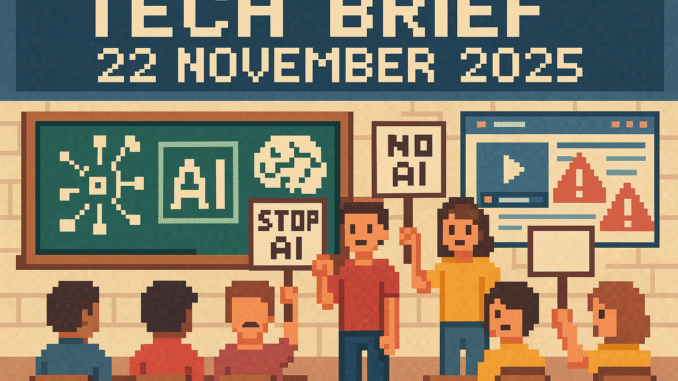
“We could have asked ChatGPT for this.” Tech Brief 22 November 2025 lands with students, regulators, and Concorde all up for review. No tidy theme, just a candid survey of who gets to steer, who gets left behind, and what we keep carrying forward. Missed yesterday’s Tech Brief? Catch up here before diving in.
Students Protest Staffordshire Course Reliant on AI Teaching Materials
“Robbed of knowledge and enjoyment.” Staffordshire students are not mincing words after discovering their government-funded cybersecurity apprenticeship was built around AI-generated videos, half-baked file names, and digital voiceovers that barely passed for human. Forty-one learners paid for honest, human teaching. What they received was content that looked suspicious and felt impersonal.
Universities used to promise collaborative, hands-on experience. This shift to automation undermines the personal connection that makes real learning stick. For a generation raised on advice from actual teachers, the move is a shortcut, not a leap. One student’s complaint rings true: it’s not just about skills or tools; it is about being seen and heard by a person who’s been there. Yes, you could Google the answer, but nobody Googles mentorship.
Ofcom Faces Doubts on Online Harms Regulation
How do you regulate a space that rewrites itself daily? UK Technology Secretary Liz Kendall publicly scolded Ofcom for lagging on the Online Safety Act, warning that slow progress could undermine public trust in the regulator. Parliament wants to see results on everything from rogue chatbots to harmful content, but the pace of change online is relentless.
Trust is now a limited commodity. The people who built the internet during its DIY era might have scoffed at the thought of official rules. Today, there is a growing sense those wild years planted the seeds of our current digital headaches. Institutions meant to protect can just as easily fail if they lag behind. Is a watchdog that chases yesterday’s harms really keeping the public safe, or just ticking boxes?
Post Office Horizon Scandal Broke Faith in British Justice
Cold fact: subpostmasters were told, flat out, “No jury would believe the Post Office had a dodgy computer.” Academic research now details how the Horizon IT scandal was not just a technical breakdown. It unravelled a core British legal value, the presumption of innocence. Defendants faced prosecution on the presumption that machines never lie.
Police and management dismissed all human testimony, clinging to their faith in the shiny new central system. Innocent people lost careers, reputations, and, for some, their health. All because the computer’s word was law. There is a gut punch there, especially for anyone who grew up seeing computers as helpers, not judges. Few stories speak so directly to the human cost of technical infallibility. Sometimes, the system is broken, and the experts are just as fallible as the rest of us.
Concorde’s JFK Route Remains a Supersonic Milestone
What does a jet from 1977 have to do with today’s tech anxieties? Everything, if speed and national ambition still pique your interest. On this day, British Airways made supersonic flight practical by launching Concorde service between Heathrow and JFK. Concorde’s ogival delta wing, Olympus 593 engines, and its moveable nose for better pilot visibility during landing and taxiing were at the edge of what aerospace could achieve.
British and French engineers did not stop for regulators or protesters. They burned fuel at Mach 2 and called it progress. The plane’s brief reign still makes the headlines whenever someone pitches a “return of supersonic.” Today, the lessons land differently. Innovation is brilliant, but every leap stirs new doubts, loud debates, and sometimes a return to basics. Concorde was gorgeous and unsustainable, fast and exclusive. Like plenty of digital dreams, some marvels live on as measured warnings.
From the Wayback Machine
On This Day: 1977. Concorde’s regular transatlantic service from Heathrow to JFK began, setting a precedent for supersonic travel. Four Rolls-Royce/Snecma Olympus 593 engines powered the aircraft to Mach 2.04. The typical journey took about three hours, halving the usual Atlantic flight time. For decades, Concorde remained unmatched in speed and ambition. Supersonic flight ended in 2003, but the aircraft’s profile is instantly recognisable. Efforts like Boom Supersonic prove that the legacy’s tension between progress and practicality remains as sharp as ever.
Today’s Big Question
Tech Brief 22 November 2025 has me asking who gets to draw the line. Is it students calling for human teachers, or regulators scrambling after yesterday’s online harms? Does a dazzling jet promise progress or warn us what we risk losing when speed outpaces substance?
Stay curious, keep your toolkit handy, and don’t trust a computer just because it hums reassuringly.
Missed yesterday’s Tech Brief? Catch up here
Leave a Reply