
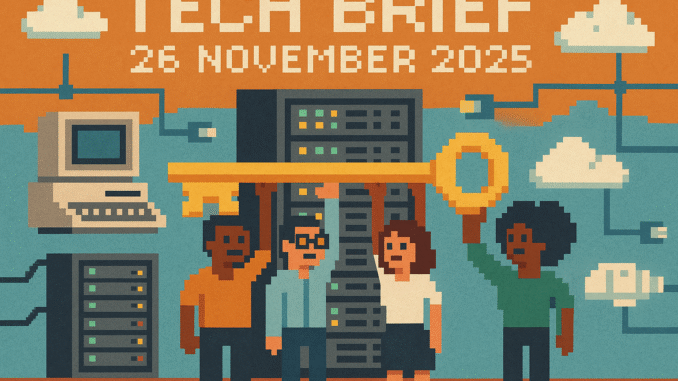
Can you pinpoint the moment the web first let you down? Tech Brief 26 November 2025 lands with stories that cut through nostalgia and challenge what digital trust looks like today. From the slow hollowing out of online spaces to a hard reckoning on AI abuse, this round-up keeps one foot in the server room and one eye on who’s holding the keys.
Missed yesterday’s Tech Brief? Catch up here before diving in.
“Enshittification” Exposed: Doctorow Names the Internet’s Decline
“We thought we were building a digital playground. Instead, they sold us the sandpit.” Cory Doctorow’s new podcast unpacks why the web now feels emptier, even as it appears more crowded than ever. Platforms once open have morphed into slick, ad-fuelled traps, where every visitor is a commodity. Doctorow calls this enshittification, the slow rot as profit squeezes out purpose.
In Britain, that means swapping Demon dial-up and CIX camaraderie for algorithmic feeds chasing engagement, not connection. Old forum posts from 1999 already saw it coming, raising the alarm when ads started nudging their way in. The shift is now obvious, unless you still run your own IRC server or meticulously archive your private web pages.
This story is less about nostalgia, more a practical warning. Tech users aren’t just customers anymore. Most have become the product. The fix? Tinker, self-host, stay stubborn.
Alarming Attitudes Toward Deepfake Abuse Revealed
One in four adults shows indifference, even approval, toward non-consensual deepfake pornography in a new UK police survey. Does this shock anyone who watched the early optimism of British net culture curdle into cynicism? This isn’t a side effect of AI, it’s a cultural fork in the road.
Senior officers describe tech platforms as asleep at the wheel. Rapid advances in image synthesis and neural networks have outpaced any meaningful checks. Digital ethicists point out how hands off platforms turn a blind eye. Archive interviews from early .uk newsgroups worried about where ‘openness’ might lead. They rarely pictured this.
It’s a grim update. By tolerating digital abuse, we risk normalising it. If the early internet was about radical openness, today’s reality demands responsibility. Will industry and lawmakers finally treat emerging harms as a design flaw, not a user error?
Britain Warned: Focus On Tech Differentiation, Not AI Supremacy
Ask Llion Jones, one of Google’s original AI transformer architects, for his forecast and you won’t get a pep talk. “Britain won’t outmuscle America or China in hyperscale AI,” says Jones, citing gaps in scale, talent retention, and government tempo. The solution: build different, not bigger.
There was always a “make do and mend” streak in British computing. Think Acorn’s clever chips or Sinclair’s tape-deck hacks, each sidestepping brawn for brains. If British tech wants a global seat, Jones suggests, it must pioneer what Silicon Valley ignores, like niche tools, sovereignty finessing, or leftfield software. That’s no defeatist stance. ARM chips outlasted their Eighties rivals by going everywhere, not head to head against them.
Much like the earlier stories, who shapes the rules and who owns the hardware still matter. Trying to race the biggest engine is pointless if you can invent your own road.
Google Secures NATO Sovereign Cloud Contract
Cold fact: Google takes home a multimillion-pound win to supply NATO with sovereign cloud infrastructure, just after bagging the UK Ministry of Defence deal. The world’s security conversations aren’t whispered in corridors; they’re routed through hyperscale data centres, increasingly owned by a handful of American giants.
Defense strategists argue that cloud contract choices go deeper than spreadsheets. British tech once fought for server rooms and fibre in local ground; now the debate spreads to who holds second-by-second logs and metadata. From MOD mainframes to NATO’s serverless future, questions over digital sovereignty remain stubbornly unanswered. The callback from AI, here too, local differentiation and autonomy are everything.
Will future conflicts be won in the data centre or on the ground? It’s not clear. The only certainty: these contracts redraw the world’s digital boundaries, quietly.
From the Wayback Machine
On This Day: 1979 – British Telecom unveils the Prestel Viewdata system in London. Prestel, a videotex online information service, brought interactive computing to British living rooms years before the web. Early users accessed news, travel, and banking on TV sets with a clunky keyboard, laying the groundwork for today’s connected culture.
Today’s Big Question
Tech Brief 26 November 2025 invites a blunt question. As our infrastructure and imagination grow more private and more centralised, who decides what’s “normal” online now? Is it possible for small actors to still build and keep a world worth logging into?
Pull out your old soldering iron, or just send an email to the editor. We’re all still building, together, whether the kit is retro or not.
Missed yesterday’s Tech Brief? Catch up here
Leave a Reply