
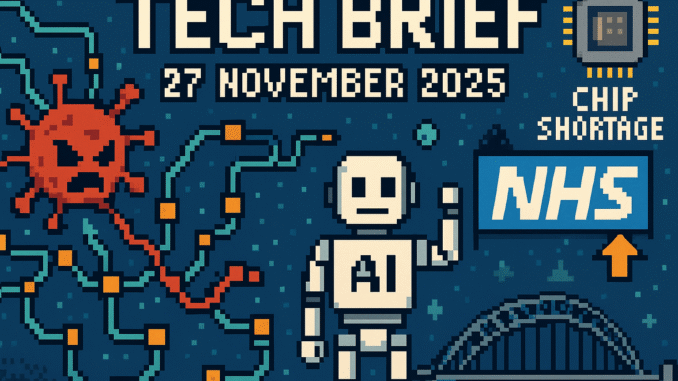
“Tech Brief 27 November 2025” arrives with alarms ringing, and old lessons creeping back through the cracks. The headlines pull no punches: cyberattacks have tripped up London’s councils, AI disruption presses a little harder on jobs and families, and the public sector races to patch decades of ageing infrastructure. Some of these stories are oddly familiar, others completely new. If you missed a headline, pause over your tea and catch up here before diving in.
London Councils Braced by Emergency Protocols After Cyberattack
“Three councils. One shared IT backbone. Unwelcome chaos.” This is how an exhausted council staffer described the aftermath of this week’s attack on Kensington and Chelsea, Westminster, and Hammersmith and Fulham. That shared digital nervous system, meant to make public services efficient, became the very thing that spread the pain.
Phone lines went silent. Online services failed. The National Crime Agency is swamped. Some staff have reverted to using paper ledgers just to keep critical records alive. If this feels a bit 1991, well, there’s a good reason. Britons living through the computerisation boom will spot the weak points. Centralised networks promise smooth running but collapse without warning when trouble strikes.
Wider lesson: Britain’s digital backbone is only as strong as its smallest, oldest link. Digital transformation is impressive, but redundancy needs more than a few backup hard drives.
AI Forecasts Three Million Jobs Lost to Automation by 2035
Start with a simple question: How do you prepare a child for a future you do not believe in yourself? That is the reality for many parents as the National Foundation for Educational Research warns that three million UK jobs are at risk of being replaced by artificial intelligence in the next decade.
Trades from machine operators to admin roles are at the heart of the threat. The report sharply contradicts the ‘safe skills’ advice handed to school-leavers in the 90s. It is hard to ignore how quickly the ground has shifted underfoot. That old promise, “get into computers, you’ll never be out of work,” today reads almost like gallows humour.
The new skill might just be learning how to adapt, over and over, without a neat endgame. Let’s stay alert as boundaries keep shifting.
Chancellor Announces £300m for NHS Digital Overhaul
Cold fact: £300 million is on the table for the NHS digital upgrade. For years, NHS infrastructure held together on legacy software, expired support contracts, and an uncomfortable number of CRT monitors. Now, this capital injection tries to close a gap that opened sometime around the turn of the millennium.
NHS Digital says the cash will modernise key systems and “unlock” productivity. That sounds good, but not everyone is convinced it will root out the oldest problems. Historic context matters here. NHS IT projects have overpromised then underdelivered before, sometimes spectacularly. The 2000s National Programme for IT cost billions, delivered little, and left hospitals struggling.
As explored above with council tech failures, digital progress can be fragile. Effective technology must be more than shiny dashboards. It needs the basics to work when it matters.
Chip Makers Warn of Looming DRAM and SSD Shortages
What happens when every hyperscale cloud company starts buying chips at the same time? Shortages. Reports this week confirm that DRAM modules and SSD drives are facing a squeeze that could last into 2027. Analysts say competition for these components is fierce because AI infrastructure is devouring capacity far faster than anyone forecast.
For buyers, this means higher prices and longer waits. For anyone who once swapped RAM sticks at a local microfair, it is a strange sense of deja vu. Hardware is still physical, still finite, and can still stop the show. There is a loose thread weaving through today’s stories; digital dreams rise and fall on old-fashioned parts.
Do you stockpile rare hardware, or trust the market to catch up eventually?
From the Wayback Machine
On This Day: 1990 – Channel Tunnel Breakthrough connects Britain and France. Engineers Graham Fagg and Philippe Cozette met in the darkness beneath the Channel, finally uniting the rail lines of Europe. With precise tunnelling, binational teams put modern ideals to work. The legacy is still visible every time a train slips quietly under the sea. Some feats reach further than a fibre optic cable ever will.
Today’s Big Question
Every part of Tech Brief 27 November 2025 hints at an old worry made new again. Can we build digital systems as resilient and joined up as those binational tunnellers? Do we even want that, or is the occasional reset what keeps this all human? Tomorrow’s hacks are waiting. Good thing some skills age well.
Swap stories about your own favourite crisis fixes or missing parts. Curiosity keeps us honest, even when the tech will not.
Missed yesterday’s Tech Brief? Catch up here
Leave a Reply